

 Op werkdagen voor 21.00 besteld, morgen in huis
 Gratis thuisbezorgd vanaf € 90,-
Are you aware of the importance of vitamin K? For a long time we thought that vitamin K was only needed for healthy blood clotting. But vitamin K-dependent proteins have now also been found in blood vessel walls, bones, lungs and other organs, and interest in this protein is therefore increasing.
Vitamin K deficiency is an underestimated problem for the health of our heart, blood vessels, bones and other organs.
Read this blog and become aware of the importance that this relatively unknown vitamin can have for your health and what you can easily do about your vitamin K status.
Recent studies show that for at least 40% of people in the West, the vitamin K status is so low that it has measurable clinical consequences, including increased susceptibility to disease and reduced life expectancy.
What happens with a vitamin K deficiency?
When deficient, our body focuses on short-term survival at the expense of long-term survival such as healthy aging with healthy bones and healthy blood vessels. For Vitamin K, the short-term focus is to prevent bleeding but not to protect the heart, blood vessels and bones.
As a result of this blog, I hope that you have become (more) aware of the importance of vitamin K and especially K2 for your health, that you can properly assess the risk of a deficiency and that you can adjust your diet accordingly.
History of vitamin K
Vitamin K is probably the least known vitamin. It is not common in the Western diet and has not received much attention compared to other vitamins. Yet this vitamin plays an essential role in many aspects of our health.
In fact, vitamin K2, like omega-3 and vitamin D3, could be the missing link between diet and chronic diseases.

We have known since 1935 that vitamin K is necessary for normal and healthy blood clotting. The “K” comes from the Danish word “Koagulationsvitamin” (clotting vitamin). In 1980 it was discovered that this vitamin also plays a role in the production of proteins in other tissues, such as bone, blood vessel wall, kidney and lung.
Professor Vermeer investigated vitamin K
Professor Cees Vermeer has published more than 400 scientific publications in the field of cardiovascular disease and through his studies much more has become known about the effects of vitamin K1 and K2.
His work shows that in addition to the health of the heart muscle, heart valves and arteries, vitamin K2 is also important for the prevention of osteoporosis, for good kidney and lung function, obesity and metabolic syndrome and in general for longer life expectancy .
The health benefits of vitamin K
Vitamin K is involved in blood clotting and the production of certain proteins in the liver, bone, teeth, cartilage and the blood vessel walls of our arteries.
The proteins that depend on vitamin K have the following function:
- Blood thinning and blood clotting
- Preventing calcification of, among other things, veins and cartilage
- It ensures proper calcification of bones and teeth
- Regulating cell growth in various soft tissues
Many vitamin K-dependent proteins, such as clotting factors, are formed in the liver, but it is becoming increasingly clear that vitamin K also plays an important role outside the liver.
Vitamin K has 2 main forms
Vitamin K belongs to the fat-soluble vitamins and is divided into:
– vitamin K1, of plant origin , also known as phylloquinone and
– vitamin K2, made by bacteria , also known as menaquinone
If you give someone a mixture of K1 and K2, both forms are absorbed from the intestine, incorporated into triglycerides (read fats) and sent to the liver. That is the normal route of metabolism.
The liver then mainly extracts vitamin K1. This remains in the liver and is mainly involved in the formation of blood clotting factors.
Vitamin K2 is preferably incorporated into the LDL particles, which transport it from the liver to the other organs.
Vitamin K2 is mainly absorbed into the blood vessel wall and from there it plays its role in cardiovascular and bone health.
Vitamin K and blood clotting
Vitamin K is necessary for normal hemostasis (which is our body's mechanism to prevent blood loss - i.e. both dilution and clotting), which is also evident from the health claim approved by the European Food Safety Authority (EFSA):
Permitted health claim: Vitamin K contributes to normal blood clotting and proper blood clotting.
Vitamin K is an essential helper in the production of blood clotting-stimulating and blood clotting-inhibiting proteins . These proteins contain in the active form certain unusual amino acids that come from the action of vitamin K.
Optimal blood clotting only occurs when all these proteins are fully active.

Unfortunately, in most of the population the vitamin K status of the blood vessels is low and not all proteins are sufficiently activated, resulting in an increased risk of thrombosis .
This is especially important for individuals with more risk factors such as being overweight, being bedridden, long plane trips, using the pill and smoking cigarettes.
Vitamin K intake reduces this unnecessary risk of thrombosis.
Vitamin K2 deficiency can lead to osteoporosis
Osteoporosis is often accompanied by arteriosclerosis, especially in women after menopause. And at the same time, low bone density is associated with higher mortality from cardiovascular disease in the elderly.

Calcium is a mineral that is necessary for the building of bone tissue.
Due to age and hormonal changes during menopause, more bone tissue is broken down than created. This can lead to bone decalcification, also called osteoporosis.
Sufficient calcium in our first 30 years of life determines good bone density later in life and reduces the risk of osteoporosis and bone fractures later in life. The highest bone mineral density, the so-called “peak bone mass”, is reached around the age of 30. Until then, bone production exceeds bone breakdown. Afterwards, bone production gradually decreases and with it the density of our bones.
Calcium pills can actually lead to arteriosclerosis instead of strong bones if the calcium does not end up in the right place in your body.
People who take calcium pills are at a higher risk of having a heart attack . The extra calcium ends up in the wrong place in the body: in the veins instead of the bones.
A calcium deficiency in the bones must be resolved in a different way than by taking calcium alone.
Always combine calcium tablets with Vitamin K and D

Vitamin D ensures proper absorption of calcium by the intestines, regulates the level of calcium in the blood and helps with the absorption of calcium by the bones. In addition, it stimulates the production of certain vitamin K-dependent proteins in blood vessels and bones.
The important role of Vitamin D is supported by the EFSA with the following approved health claims :
Approved health claim: vitamin D contributes to the absorption of calcium and phosphorus from food and to a normal/good calcium level in the blood .
Vitamin K is then needed to activate the vitamin D-stimulated proteins in blood vessels and bones.
Vitamin K-dependent proteins (MGP) inhibit the calcification of soft tissues in, among other things, the veins by binding to calcium. As a result, vitamin K ensures flexible and elastic veins .
It then transports the calcium from the veins to the bones. There, another vitamin K-dependent protein (osteocalcin) then regulates the formation and calcification of bone tissue.
The important role of vitamin K is supported by the EFSA with the following approved health claim :
Approved health claim: Vitamin K contributes to the maintenance of normal strong bones .
Especially for women around menopause, a high vitamin K intake is important to prevent bone fractures due to osteoporosis.
Would you like to read more about menopause? Leen Steyaert , an expert in this field, is our scientific advisor and you will find some of her bestsellers in our shop.
How much vitamin K is recommended?
These levels are based on what is needed for healthy blood clotting :
- The adequate intake (AI) for vitamin K used within the EU is 75 μg per day .
- The World Health Organization (WHO) sets the RDA slightly higher, at 1 μg/day per kilogram of body weight, or roughly 90-120 μg/day.
Extensive studies have shown that tissues such as bone and blood vessels require a higher intake of vitamin K. And this need is generally not met with a Western diet.
Furthermore, no distinction is made between vitamin K1 and K2. K1 is important for blood clotting, while K2 is important for blood vessels and bones.
According to Prof. Vermeer , vitamin K expert, the daily vitamin K intake in the general population should be 90 μg/day K1 and 180 μg/day K2.
Measured as the total of what you consume through your diet and/or supplements.
Improving vitamin K status: nutrition and supplementation
It is preferable to increase your vitamin K intake by adjusting your diet.
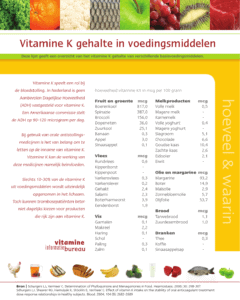
Green vegetables (kale, spinach, Brussels sprouts and broccoli) are the main dietary sources of vitamin K1 and contribute 80-90% of the total vitamin K intake.
100 grams of green vegetables contain approximately 400 μg of vitamin K1. If you consume 100 grams of broccoli or spinach twice a week, the vitamin K1 intake is an average of more than 90 micrograms per day and that is sufficient in most cases.
Fermented foods (mainly cheese and cottage cheese) are the main sources of vitamin K2.
Vitamin K2 is originally known from natto, fermented soybeans that are commonly eaten for breakfast in certain parts of Japan. This contains a very high dose of vitamin K2.

It has a strong taste and a slimy character which is usually not appreciated by us in the West. It contains 1100 micrograms of vitamin K2 per 100 grams and is by far the cheapest source of vitamin K2.
If natto is not an option, it is important to regularly eat hard cheese (Goudse, Edam) or (low-fat) cottage cheese. By eating 100 grams of cheese and 100 grams of cottage cheese together per day, you achieve an intake of 90 micrograms of vitamin K2 per day.
If consuming the recommended doses of vitamin K2 through food is not feasible, consider using a nutritional supplement ( click here if you would like to see our alternative).
Vitamin K2 is a fat-soluble vitamin.
So always take a supplement with a fatty meal or together with an omega-3 supplement.
What is a safe dose of vitamin K?
Vitamin K1 and vitamin K2 have no toxic effects . An upper intake limit could not be determined on the basis of toxicological research.
Excessive vitamin K intake during pregnancy (particularly synthetic K3) increases the risk of jaundice in the newborn and should be avoided. Taking vitamin K while breastfeeding is safe.
Vitamin K supplements should not be used in combination with oral anticoagulants (vitamin K antagonists such as Warfarin, Coumadin, Sintrom or Marcoumar).
Always consult your doctor first and also take a look at the website of the National Thrombosis Service .



Comments (0)
There are no comments for this article. Be the first one to leave a message!